Pipeline Features
The Consistency module
The CosmoSIS standard library has a particularly helpful module called consistency, which is designed to translate automatically between different ways of expressing cosmological parameters.
For example, if your values file specifies both \(\Omega_m\) and \(h^2\) then it will calculate \(\omega_m \equiv \Omega_m h^2\) for you automatically.
Any sufficient choice of the parameters can be specified and the remainder will be determined.
To use this module, just include the module utility/consistency/consistency_interface.py at the start of a pipeline.
Short-cutting modules
You may have a situtation where the output of the first few pipeline modules does not change as the parameters vary.
For example, if you are fixing cosmological parameters, but varying other parameters, then the outputs of early modules in the chain may be fixed.
In this case you can set a “shortcut”, which tells CosmoSIS to only run the first few modules once, and then re-use the results from them for all the other parameter points. You do so like this:
[pipeline]
...
modules = module_1 module_2 module_3 module_5 module_5
shortcut = module_3
This tells CosmoSIS to run modules 1, and 2, only the first time the pipeline is run, and then to re-use their results for all later parameter points. It will then run modules 3, 4, and 5 only for each subsequent points.
Pre- and post-scripts
CosmoSIS can automatically run a script before executing your pipeline; if the script returns an error code then the pipeline will not be run.
It can also run a script after the
You could use this feature to: - run a check before the pipeline to make sure some test result is as expected. - download some data that is needed for a pipeline. - postprocess results after the pipeline is complete and make some plots.
To use this feature, add lines in the [runtime] section of the parameter file:
[runtime]
pre_script=./my_pre_script.sh
post_script=./my_post_script.sh
Your scripts can be any executable. If the pre-script has a non-zero return value then the pipeline will not run.
Making pipeline graphs
You will need the pygraphviz tool to use this feature. On Conda, you can install it with:
conda install -c conda-forge pygraphviz
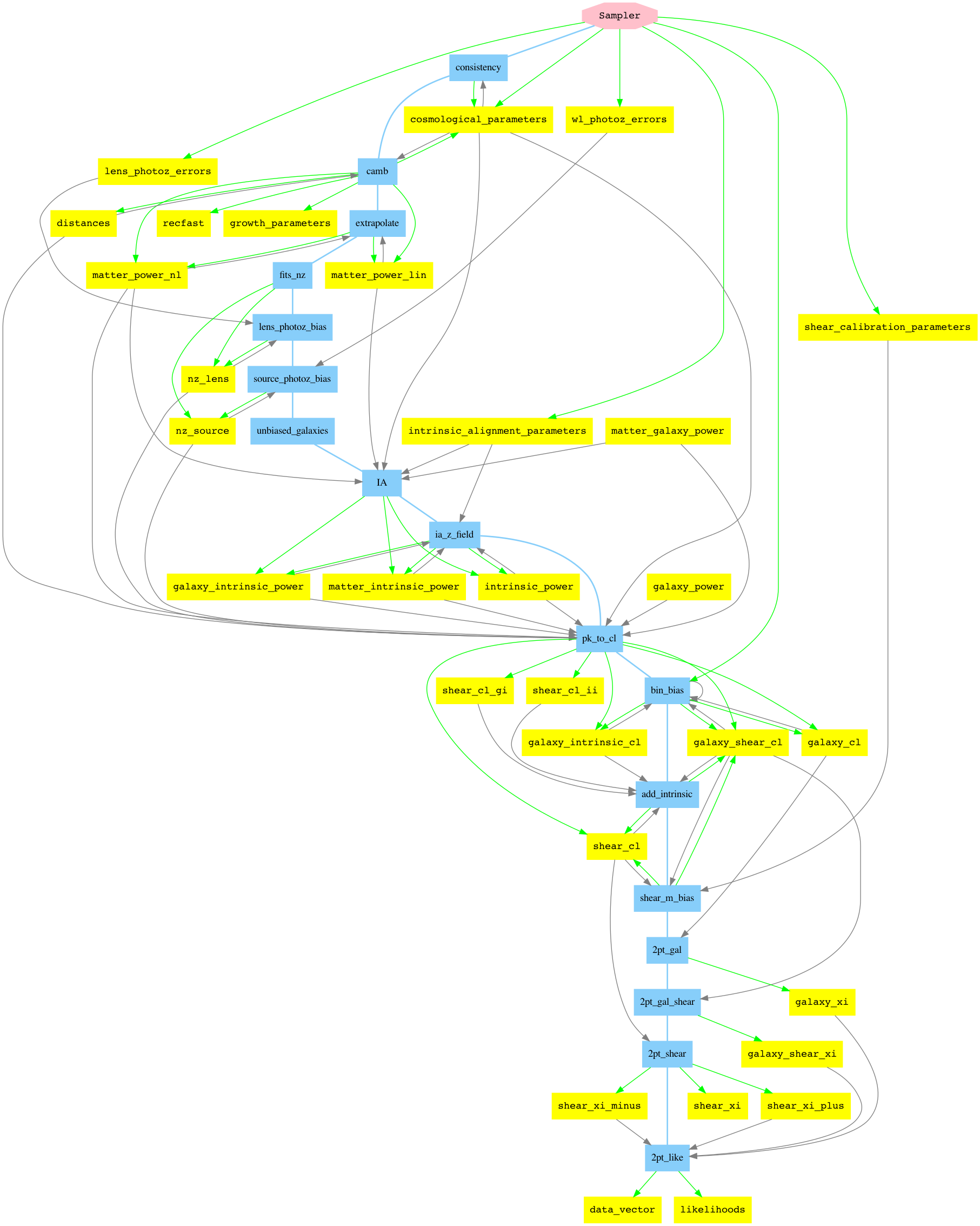
Then you can create a graph from the command line using the --graph flag and then the graphviz dot command:
cosmosis --graph des-y1.dot  examples/des-y1.ini
dot -Tpng -o des-y1.png des-y1.dot
And example is shown below:
Making a pipeline from a single likelihood function
If you have a single likelihood function that you want to use as a pipeline (so that you are really just using CosmoSIS for its sampling features), then you can do it like this:
import cosmosis

def log_like(x):
    # your likelihood function here
    return log_like

param_ranges = [
    (-1.0, 0.0, 1.0),
    # ...
    # min, start, and max of each parameter of the likelihood
]

pipeline = cosmosis.LikelihoodPipeline.from_likelihood_function(log_like, param_ranges)
You can now test your pipeline, calling pipeline.posterior or pipeline.likelihood, or run a sampler like this:
sampler_config = {
    "runtime": {
        "sampler": "emcee",
        "verbosity": "quiet",
    },

    "emcee": {
        "walkers": 100,
        # ... other emcee parameters
    },
}

status, output = cosmosis.run_cosmosis(sampler_config, pipeline=pipeline, output='astropy')
The output will be an astropy table with the samples and likelihoods.
You can also use derived parameters or supply non-uniform priors. See the LikelihoodPipeline.from_likelihood_function docstring for details.